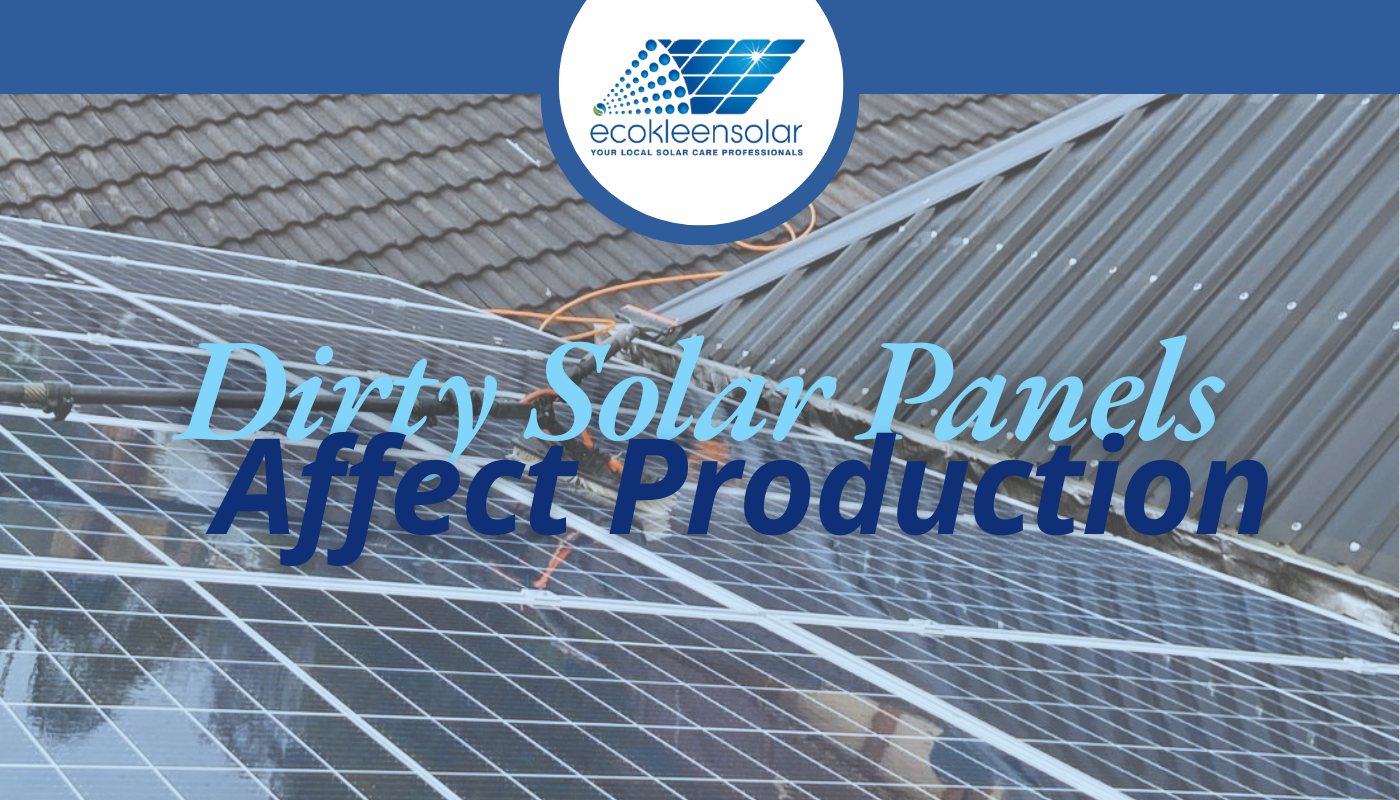
Winter is often the season that catches solar panel owners off guard. You notice your electricity bill creeping up, your solar app showing lower generation numbers, and you assume it is simply the shorter days doing their damage. While reduced daylight hours and a lower sun angle are genuine factors in winter energy production, there is a far more controllable culprit that most homeowners overlook entirely: the layer of dirt, dust, bird droppings, and environmental grime quietly building up on the surface of their panels.
Understanding how dirty solar panels affect energy production during winter is not just a matter of curiosity, it is a practical concern that directly impacts your electricity savings, your return on investment, and the long-term health of your solar system.
At EcoKleenSolar Newcastle, we see the real-world consequences of neglected panels every single day, and the difference a professional clean makes is often remarkable. This guide walks you through the science, the seasonal factors, the financial impact, and what you can do to protect your investment throughout the cooler months.
Why Winter Is the Worst Season for Dirty Solar Panels
To understand why winter amplifies the problem of dirty solar panels, it helps to first understand how solar panels actually work. Photovoltaic (PV) panels generate electricity by allowing photons from sunlight to knock electrons loose in the silicon cells beneath the glass surface. The more unobstructed sunlight that reaches those cells, the more electricity is produced. Any barrier between the sun and the cells, whether it is a cloud, a shadow, or a film of grime, directly reduces the amount of energy generated.
During summer, the sun sits high in the sky, delivering intense, direct light to your panels for many hours each day. Even with some soiling on the surface, the sheer volume of sunlight often compensates for the efficiency loss. But in winter, the equation changes dramatically. The sun traces a lower arc across the sky, meaning sunlight hits your panels at a shallower angle. This not only reduces the intensity of the light but also means that any dirt on the surface has a proportionally greater impact on the amount of light that ultimately reaches the solar cells.
Think of it this way: if you hold a dirty window up to a bright midday sun, you can still see clearly through it. But hold that same dirty window up to the pale, low winter sun, and the grime becomes far more obstructive. The same principle applies to your solar panels. A layer of soiling that barely dents your summer output can cause a meaningful reduction in energy production during the months when you can least afford it.
What Is Actually on Your Solar Panels?
Many homeowners imagine that what settles on their solar panels is simply a thin layer of dust that a good rain will wash away. The reality is considerably more complex, and understanding what is actually accumulating on your panels helps explain why professional cleaning is so important.
Dust and fine particulates are the most common form of soiling. In the Newcastle, Hunter Valley, and Central Coast regions, this can include fine soil particles, pollen, and industrial or traffic-related pollution. These particles settle gradually and, over time, form a diffuse layer that reduces the transparency of the glass.
Bird droppings are among the most damaging forms of soiling for solar panels. Unlike dust, which spreads relatively evenly, bird droppings create concentrated spots of blockage. Because solar panels are wired in series, a single shaded or blocked cell can drag down the performance of an entire string of panels, a phenomenon known as the “Christmas lights effect.” A single bird dropping in the wrong place can reduce the output of an entire panel, or even a row of panels, by a far greater percentage than its small physical size would suggest.
Leaf litter and organic debris are particularly common in residential areas with established trees. Leaves, bark, and seed pods can accumulate along the bottom edge of panels, trapping moisture and creating conditions for mould, lichen, and algae to take hold. Once biological growth establishes itself on a panel, it is far more difficult to remove and can cause lasting damage to the glass surface if left untreated.
Pollution and exhaust residue from nearby roads, industrial areas, and even backyard burning can deposit a sticky, oily film on panel surfaces. This type of soiling does not wash off with rain and requires proper cleaning agents and techniques to remove effectively.
The Rain Myth: Why Rainfall Is Not Enough
One of the most persistent misconceptions in the solar industry is the idea that rainfall will keep your panels clean. It is an understandable assumption; after all, rain washes everything else, so why not solar panels? The truth is that rain is a poor substitute for professional cleaning, and in some cases, it can actually make the problem worse.
Light rain, which is the most common type of rainfall in the Newcastle and Hunter Valley region during winter, does not generate enough force to dislodge caked-on bird droppings, sticky pollution residue, or biological growth. What it does do is wet the dust already on the panels, turning it into a muddy slurry that then dries into a harder, more stubborn layer of grime. This is why panels often look worse after a light shower than they did before.
Even heavy rainfall, while more effective at removing loose dust, leaves behind mineral deposits as the water evaporates. Tap water and rainwater both contain dissolved minerals, and when these dry on the glass surface, they leave behind a fine white residue, sometimes called water spotting, that can reduce light transmission over time. Professional cleaning uses purified, deionised water specifically to avoid this problem, ensuring that panels are left streak-free and spotlessly clean.
How Soiling Interacts With Winter’s Lower Sun Angle
The geometry of winter sunlight is worth exploring in a little more detail, because it is central to understanding why dirty panels are such a significant problem during the cooler months.
In Newcastle and the surrounding regions including Lake Macquarie, Port Stephens, Maitland, and the Hunter Valley, the sun’s elevation angle at solar noon drops considerably during winter compared to summer. During the summer solstice, the sun reaches a high elevation, delivering near-perpendicular light to north-facing panels. During the winter solstice, that elevation angle is much lower, meaning sunlight strikes the panel surface at a more oblique angle.
When light hits a surface at an oblique angle, it has to travel through more of the surface material before reaching what lies beneath. In the context of dirty solar panels, this means that winter sunlight has to pass through a greater effective thickness of the soiling layer, resulting in more light being absorbed or scattered by the dirt before it ever reaches the photovoltaic cells. The practical consequence is that the same amount of soiling that causes a 10% efficiency loss in summer might cause a 15% to 20% loss in winter, simply because of the geometry of the light.
This compounding effect, reduced sunlight hours, lower sun angle, and amplified soiling impact is why winter is the season when clean panels matter most. It is also why we strongly recommend scheduling a professional clean before winter sets in, so your system is operating at peak efficiency during the months when every kilowatt-hour counts.
The Hidden Problem: Hotspots and Long-Term Panel Damage
Beyond the immediate loss of energy production, dirty solar panels can cause a more insidious form of damage known as hotspots. When a portion of a solar panel is shaded or blocked whether by a bird dropping, a patch of lichen, or accumulated leaf matter, that section of the panel can no longer generate electricity. Instead, it begins to absorb energy from the rest of the panel, causing it to heat up dramatically.
These hotspots can reach temperatures significantly higher than the surrounding panel surface, and over time, they can cause permanent damage to the photovoltaic cells, the encapsulant material, and even the glass itself. In severe cases, hotspots can cause cells to crack, delamination of the panel layers, or discolouration that permanently reduces the panel’s output capacity. What began as a bird dropping that could have been removed with a professional clean can, if left long enough, result in a panel that needs to be replaced entirely.
Regular cleaning and inspection are the most effective ways to prevent hotspot damage. At EcoKleenSolar Newcastle, our service includes not just a thorough clean but also a detailed system inspection, allowing our technicians to identify any potential issues including early signs of hotspot damage, loose wiring, or compromised mounting hardware before they become costly problems.
When Should You Schedule a Solar Panel Clean?
The ideal time to schedule a professional solar panel clean is before the onset of winter, ensuring your system enters the low-sunlight season in peak condition. However, there are several signs that your panels may need attention regardless of the time of year.
If you notice a visible layer of dust, grime, or bird droppings on your panels, that is the most obvious indicator. But because panels are typically installed on rooftops and not easily visible from ground level, many homeowners do not realise how dirty their panels have become until they check their system’s performance data. A sustained drop in energy generation that cannot be explained by weather conditions alone is a strong signal that soiling may be the culprit.
As a general rule, solar panels in the Newcastle, Hunter Valley, and Central Coast regions benefit from a professional clean at least once a year, with twice-yearly cleaning recommended for systems in areas with high bird activity, nearby coal mining activity near coastal salt air, where panels are subject to tree sap soiling from nearby trees, or close to busy roads and industrial areas. After significant weather events such as dust storms, which can deposit a surprisingly thick layer of fine particles across the region, an unscheduled clean may also be warranted.
Why Choose EcoKleenSolar Newcastle?
EcoKleen Solar Newcastle is a family-owned and operated business with over 20 years of experience in sales and operations across multiple industries. We are passionate about helping homeowners across Greater Newcastle, the Central Coast, Lake Macquarie, Port Stephens, Maitland, and the Hunter Valley get the most from their solar investment.
Our professional cleaning service uses purified, deionised water and industry-approved techniques to safely and thoroughly clean your panels without voiding your warranty or risking damage to the glass or frame. Every clean is accompanied by a detailed system inspection, giving you peace of mind that your system is not only clean but also safe and operating correctly. We provide before-and-after photos and a comprehensive report so you can see exactly what our team has done and the condition of your system.
With over 900 Google reviews, our reputation speaks for itself. Our clients in Newcastle, Charlestown, Warners Bay, Swansea, Cessnock, Singleton, Nelson Bay, and across the broader Hunter and Central Coast regions trust us to deliver reliable, professional service at a competitive price. We are punctual, friendly, and honest, values that are at the heart of everything we do.
If you are ready to stop losing money to dirty solar panels and start maximising your system’s performance this winter, we would love to hear from you. Contact EcoKleenSolar Newcastle today for a free, no-obligation quote and take the first step towards a cleaner, more efficient solar system.
Final Thoughts
Winter is not the time to let your solar system underperform. With shorter days and a lower sun angle already working against you, dirty solar panels are a problem you simply cannot afford to ignore. The combination of reduced sunlight, amplified soiling effects, and the risk of long-term panel damage makes professional cleaning one of the most cost-effective investments a solar panel owner can make before the cold weather arrives.
Whether you are in Newcastle, Lake Macquarie, Port Stephens, Maitland, the Hunter Valley, or the Central Coast, EcoKleen Solar Newcastle is here to help. Our expert team is ready to clean, inspect, and protect your solar system so it delivers the energy savings you invested in all year round, not just in summer.
Stay Connected With EcoKleenSolar Newcastle
If you’d like to learn more about keeping your solar panels clean and operating at peak performance, we’d love to help.
For more information about our services, pricing, and service areas, visit our main website:
If you’d like to book a service or ask a question, feel free to reach out through our contact page:
Facebook: https://www.facebook.com/EKSNewcastleLakeMacquarie/
Instagram: https://www.instagram.com/eksnewcastlelakemacquarie/